
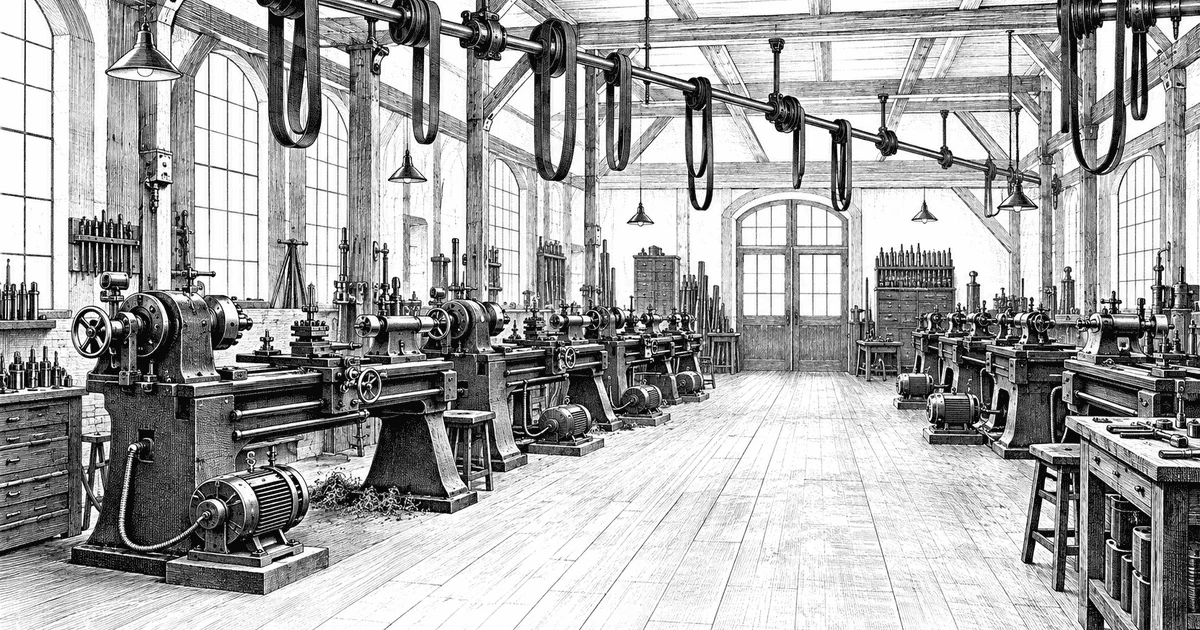
“AI is the new electricity” means AI is a general-purpose technology, like electric power: it doesn’t do one job, it changes how every job can be done. Electricity’s history also shows the order things happen in. First we substitute the new power into the old process. Then, much later, we reimagine the process around it, and that is where the money is.
Andrew Ng made the line famous in 2017, and most people stopped at the slogan. I think the history behind it is more useful than the slogan.
Phase one: swap the engine, keep the factory
On the afternoon of 4 September 1882, Edison gave the signal to close the switch at the Pearl Street station in lower Manhattan. Six big dynamos, about 85 customers on day one. The technology worked.
Then, for almost 20 years, not much happened where the real money was: the factory. As Tim Harford tells it for the BBC, by 1900 electric motors provided less than 5% of mechanical drive in American factories. Warren Devine’s study puts steam at about 80% of drive capacity around then.
The reason is simple. Owners took out the big steam engine and put in a big electric motor. Same building, same central shaft running the length of the floor, same belts. Many were disappointed and kept choosing steam until around 1910.
That’s where most companies are with AI today. We put a model where a person or a piece of software used to be, in a process designed for the old engine. It helps. It’s not the big win.
Phase two: redesign the factory around the motor
The payoff came when people asked a different question: what would a factory look like if power were small, cheap and available at every machine?
The answer was a motor on each machine instead of one giant shaft. Buildings no longer had to be built around a drive line. They could be single-story, laid out by the flow of work. Harford, drawing on the economist Paul David, stresses that this took new architecture, new processes and new ways of training and paying workers. Slightly more than half of US factory drive was electrified by the early 1920s, and that’s the decade productivity took off. By 1929 motors were about 78% of drive capacity.
Forty years from Pearl Street to the boom. The technology was ready long before the organizations were.
David himself warned that computers are not dynamos, and the analogy has limits: AI moves faster and nobody has to string copper to every office. But the lesson about organizations holds. The gain isn’t in the component, it’s in the redesign. For AI, that means asking what a team or a product looks like when language and judgment work are cheap on every desk. It’s why I care about questions like when multi-agent setups actually make sense and how to measure an agent by the outcome it delivers.
The biggest uses weren’t even in the plan. Power stations were selling light. On 2 November 1920, Westinghouse’s KDKA broadcast the Harding-Cox election returns, and within four years the US had 600 radio stations. A new industry that couldn’t exist without cheap power. I expect AI to produce categories like that too, ones we don’t have names for yet.
Early electricity was scary, and it was fixed with standards
Today’s main reason to go slow is fear: AI makes mistakes, leaks data, gets tricked, is hard to control. All true. Early electricity was worse. On 11 October 1889, Western Union lineman John Feeks was electrocuted on a pole in lower Manhattan, in front of a crowd, after a high-voltage lighting wire crossed a telegraph line (NYT report on his funeral). The next day the mayor ordered unsafe wires cut down.
Electricity didn’t win because people stopped being afraid. It won because the fear was turned into rules and equipment. Here is how I map those safeguards to what AI has today:
| Electricity safeguard | When | What it did | AI counterpart | When | Where it stands |
|---|---|---|---|---|---|
| Independent testing lab (UL) | Founded 1894, first test 24 Mar 1894 | Tested products before they reached buildings | Evaluations before and after launch (our guide) | Company by company | No shared lab or label yet |
| Shared installation code (NEC) | Drafted 1896, first edition 1897 | One way to wire, so inspectors could check it | NIST AI RMF and ISO/IEC 42001 | Jan 2023 and Dec 2023 | Voluntary; the RMF is guidance, 42001 sets management-system requirements |
| Law behind the code | Today enforced in all 50 states | State and local authorities make the code binding | EU AI Act | In force 1 Aug 2024 | EU only, provisions apply in stages |
| Fuses and breakers | Standard wiring practice | A fault cuts the power, not the building | Permissions and kill switches (permission-aware retrieval) | Company by company | Not standardized |
| Electrical inspectors | Today, every installation | Someone checks what was actually installed | Audit logs of what each agent did | Company by company | Not standardized |
| The grid (Niagara to Buffalo) | November 1896 | Power as shared infrastructure | Cloud model platforms | Now | Here already |
The table shows where AI actually is. The code and the law exist. The lab, the label and the breaker are still built company by company. That means safety is a job for each organization right now, not a reason to wait for someone else to finish it.
What happened to the ones who waited
The popular versions of these stories are often wrong. The accurate versions are more useful: most of these companies saw the change coming and protected the old process anyway.
The ice industry. This is the electricity-era case. In the 1920s American homes kept food cold with delivered ice. According to a study of the industry’s decline, the president of the national ice association called the home electric refrigerator a “menace” in 1922. The industry answered with subsidized iceboxes, ads and lobbying, and “firmly resisted the new technologies rather than embracing them.” It sold a record 58 million tons of ice in 1929. Six years later, as Time reported, only 60% of that business was left. The Smithsonian’s history covers the same shift.
Kodak. Engineer Steve Sasson built the first digital camera at Kodak in 1975: 8 pounds, 0.01 megapixels, 23 seconds per image. The myth is that Kodak didn’t see digital coming. MIT Sloan Management Review shows it did, and invested in it, but couldn’t rebuild a business that lived on film and paper. It filed for Chapter 11 on 19 January 2012.
Blockbuster. In September 2000, Netflix asked Blockbuster for a $50 million buyout. In Marc Randolph’s telling, CEO John Antioco struggled not to laugh. Blockbuster filed for bankruptcy in September 2010 with nearly $1bn of debt.
Nokia’s phones. In February 2011 CEO Stephen Elop wrote his “burning platform” memo: “The first iPhone shipped in 2007, and we still don’t have a product that is close to their experience.” In September 2013 Nokia agreed to sell its phone business to Microsoft in a deal worth EUR 5.44 billion including patents.
Where companies are now, and what I’d do
Deloitte’s 2026 State of AI in the Enterprise report splits organizations into thirds: 34% are starting to deeply transform with AI, 30% are redesigning key processes, and 37% use it at a surface level with little change to how they work. So a third are still just swapping motors, and the leading third is only starting. Skills are the biggest barrier.
If my company felt behind, I’d skip the big strategy deck and do four things:
- Substitute on purpose. Put AI into a few real processes now, with owners and numbers. That’s how you learn what it can do in your business.
- Wire it properly. Permissions, audit logs, evaluations and a named human owner for each agent, with NIST AI RMF or ISO/IEC 42001 as the code.
- Ask the phase-two question. For each core process: if we started the company today, would this process exist? What would we build instead?
- Leave room for new categories. Give a small team permission to build things that don’t fit today’s business. That’s where your KDKA might come from.
My guess: within a few years “AI-first” will sound as odd as “electric-first” does now. The open question is whether your company redesigned the factory, or kept selling ice.
Further reading
- AI-first operations: all our articles on running a company around agents.
- When to use multi-agent orchestration: when splitting work across agents pays off.
- AI agent audit log: the record of what each agent did, and why you need it.